
7 Psychological tricks your brain uses without you even realizing

Have you ever wondered how often your brain influences your decisions and behavior – without your even realizing it.
Sometime, you might not like a song at all when you hear it for the first time, yet after listening to it repeatedly, it become a favorite. At times, seeing the initial price seem very cheap or expensive by comparison. And occasionally, we tend to focus on information that confirms our pre-existing beliefs.
These are not merely coincidences.
Every day, our brain processes vast amounts of information at high speed. Instead of deeply analyzing every minor detail, it relies on various mental shortcuts. While these shortcuts help us make quick decisions, in certain situations, they also influence our thinking.
In psychology, many of these processes are understood as heuristics and cognitive biases.
So, what psychological tricks does your brain play on you ?
Let’s explore 7 Psychological Tricks Your Brain Uses Without You Even Realizing
Table of Contents
1. Why Does Your Brain Prefer Things You See Again and Again ?

Imagine you hear a new song for the first time. You do not find it particularly interesting.
Then you hear the same song again the next day. Later, you hear it on a friend’s phone, and then again on Instagram or YouTube. After a few days, you suddenly start liking that same song.
Why Does This Happen ?
One possible reason could be the “More Exposure Effect”.
According to this Psychological effect, repeated exposure to something can increase our sense of familiarity with it. In many situations, this increased familiarity can make us like that thing more.
How Can This Be Seen in Everyday Life ?
However, this does not mean that the more often you see something, the more you will like it. Too much repetition can have a different effect.
A Small Trick of the Brain: Sometimes, something feels comfortable to us simply because it has become familiar to us.
2. Sometimes the First Price You Hear Influences Your Next Decision.

Imagine you go to buy a jacket. The Shopkeeper tells you the price;
Original Price : 5000/-
Sale Price : 2500/-
Now 2500/- seems like a pretty good deal to you. Because you heard the 5000/- price first, you brain starts considering 2500/- a reasonable price. But if the shopkeeper had not told you the 5000/- price in the beginning. 2500/- might have seemed expensive to you.
This is an easy example of Anchoring Bias in Psychology. It is one of the psychology tricks your brain uses, where you brain takes an initial piece of information or number as a reference point and then uses it to make later judgments.
Anchoring means that information received at the beginning can influence the judgments or estimates you make later.
Did You Know ? Where can you see Anchoring in everyday Life ?
The most interesting things is that the initial number does not always have to be accurate. Even then, your brain may use it as a reference point.
3. Your Brain May Look for More Information That Confirms What You Already Believe

Suppose you believe that someone does not like you. One day, they see you but do not talk to you.
You might immediately think;
“See! I knew they didn’t like me.
But there could be many other possibilities. Maybe they didn’t notice you. Maybe they were dealing with a problem. Maybe they were in a hurry.
However, you brain may interpret that single event as evidence supporting a belief you already had.
This is called Confirmation Bias
With confirmation bias, a person may give more importance to information that supports their existing beliefs while paying less attention to information that contradicts them.
How It Affects You on Social Media
Suppose you already have an opinion about a particular topic.
You search for that topic on Google or social media.
If you keep reading only the information that matches your existing opinion, your original belief may start to feel even stronger.
Gradually, you may begin to think;
“It’s written everywhere, so I must be right.”
But here’s the important question: Did you also look at the evidence that could prove you wrong ?
That’s why, before strengthening a belief, it can be useful to ask yourself.
“What information could prove that my thinking is wrong?”
4. Why Does Something That Is Easy to Remember Feel More Common ?

Imagine that you recently saw a news report about a scary incident.
Later, if someone asks you about a similar type of danger, that same incident may immediately come to you mind.
And because the event is so easy to remember, your brain may make that danger feel much more common or likely than it actually is.
This is known as the Availability Heuristic.
It is a mental shortcut where you brain may estimate how likely or frequent something is based partly on how easily examples of it come to mind.
This is one of the Psychological Tricks Your Brain Uses without you even realizing it.
When Can This Happen?
The availability heuristic can because stronger:
- When an event has happened recently.
- When you have seen a lot of news about it.
- When the event is emotionally powerful.
- When something similar has happened to you personally.
For example, if a person has one particularly bad experience, they may later consider the same situation much riskier then it actually is.
Remember This
Something being easy to remember does not necessarily mean it is the most common. Our memory is not a statistical calculator. Sometimes, what comes to mind most easily can strongly influence how we judge reality-even when the actual numbers tell a different story.
5. Your First Impression Can Influence Your Later Judgment.

Imagine meeting someone for the first time, and they barely talk. You may immediately think, “Maybe this person is rude.” This is one of the subtle Psychological Tricks Your Brain Uses to quickly make sense limited information.
A few days later, the same person behaves very kindly and friendly toward you. Even then, your first impression may remain somewhere in the back of your mind. The Psychological Tricks Brain Uses can make an early judgment feel more meaningful then it actually is.
The human brain often tries to reach conclusions quickly using limited information. The problem is that during a first meeting, we usually have very little information about another person. This is another reason why understanding the Psychological Tricks Your Brain Uses can help us become more aware of our own judgments.
For Example :
- A quiet person is not necessarily arrogant.
- A serious-looking person is not necessarily angry.
- A person who makes a mistake is note necessarily careless.
Even someone who appears nervous during a first meeting is not necessarily socially uncomfortable. Our Brain may prefer quick conclusions, but understanding people often takes much more time. Recognizing these Psychological Tricks Brain Uses can remind us not to judge someone too quickly.
So, the next time you from a first impression:
Am I judging this person real understanding-or just from what I noticed at first ?
That simple question can help you pause before allowing one early impression to shape your entire view of someone.
6. You Brain Doesn’t Fully Calculate every Decision

Imagine having to completely calculate every small decision you make. You brain would constantly be working though possibilities, probabilities, and Psychological Tricks Your Brain Uses is to avoid this exhausting process whenever possible.
For Example:
- Which route should you take ?
- Can you really tell whether someone deserves your trust ?
- What caused that sound ?
- Is this situation safe ?
- Which product should you buy ?
- What could this person’s actions actually be trying to communication ?
If your Brain had to perform a complete analysis before making every decision, you would become mentally exhausted very quickly. That is why the brain often uses heuristics, or mental shortcuts, to make decisions with less time and mental effort. This is another fascinating example of the Psychological Tricks Your Brain Uses in everyday life.
But when does the problem begin ?
The problem can arise when we use a mental shortcut in a situation where careful thinking is actually necessary. Understanding these Psychological Tricks Your Brain Uses is important because a shortcut that works in one situation may lead to a poor judgment in another.
For instance, suppose you come across a single unfavorable review about a product. Your brain may immediately think;
“This Product is bad”
But thousands of other customers may have had completely different experiences with the same product. One example cannot always represent the entire reality.
This is why, when making important decisions, it can sometime be useful to step back from your automatic reaction and look at the bigger picture. Recognizing The Psychological Tricks Your Brain Uses gives you a chance to pause, examine the available information, and think more carefully before reaching a conclusion.
7. Something Your Brain Gives You A Feeling Before You Understand the Reason
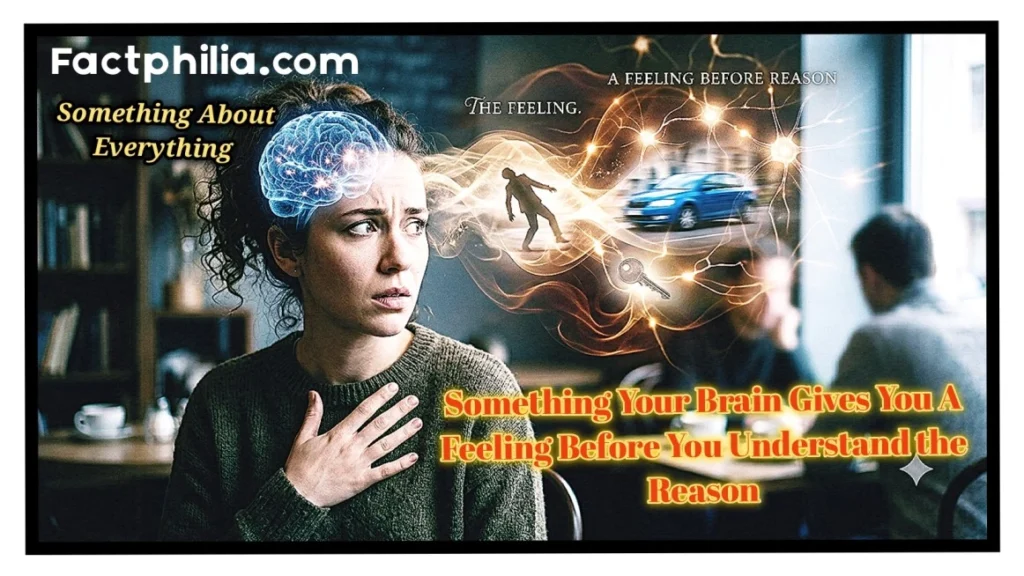
Have you ever said, “I don’t know why, but I feel the something is wrong”?
Your Brain can process information incredibly quickly by using patterns and experiences from the post. Sometime, you may not consciously notice every step of this process, yet your brain can still produce an immediate feeling or reaction. This is often associated with intuition.
But there is something important to remember:
A feeling is not always fact,
Sometime intuition can be useful, but our feeling can also be influenced by fear, past experiences, expectations, or personal biases. This is one of the fascinating Psychological Tricks Brain Uses without you consciously noticing the process.
So when you have to make an important decision, instead of relying only on your feeling, ask yourself:
- What actual facts do I have?
- Am I relying only on my first impression?
- Could there be another explanation?
- Am i only paying attention to information that matches what I already believe?
- Do I have enough evidence to support this decision?
Why Does Your Brain Do This?
Now comes the bigger question; Why does your brain use these mental shortcuts in the first place?
Your brain is constantly processing a huge amount of information. Completely analyzing every small detail would not be practical. So, the brain often uses shortcuts to reach decisions more quickly.
And many times, this can be extremely useful.
However, in certain situations, the same shortcut can lead to an inaccurate judgment. Your brain is not deliberately trying to “fool” you. It is simply trying to process information efficiently.
That is why understanding the Psychological Tricks Your Brain Uses can help you become more aware of how your own thinking works.
Can You Avoid These Psychological Biases?
Completely eliminating every cognitive bias is not easy.
That is because these biases are a natural part of human thinking.
But there is good news: awareness can help you make better decisions.
1 . Pause Before Making Big Decisions
Instead of reacting immediately, give yourself a little time to think.
2. Challenge Your First Assumption
Ask yourself: “What If My First Impression Isn’t Actually Correct?”
3. Look for Opposite Evidence
Don’t look only for information that supports your existing opinion. Try to find evidence that challenges it too.
4. Separate Memory From Reality
Something being easy for you to remember does not necessarily mean it is the most common or likel;y thing.
5. Be Careful With the First Price You See
When evaluating a price or an offer, consider how much that initial number may be influencing your judgment.
6. Listen to Another Perspective
Sometimes, an independent opinion can help you notice something you may have overlooked.
The Most Interesting Part: You Brain Is Not Your Enemy
When you hear the phrase “psychological tricks,” it may sound as if your brain is deliberately playing games against you.
However, that may not be the most accurate way to understand it.
Many of these processes are simply normal parts of human cognition.
Your brain is constantly working to understand the world, recognize patterns, and make quick decisions.
These mental shortcuts can often help you respond more quickly and efficiently.
But sometimes, those same shortcuts can also lead you toward the wrong conclusion.
So, the goal should not be to make sure your brain never makes a mistake.
The real benefit is learning to notice when your mind is relying on a mental shortcut.
Final Thoughts
Your brain quietly shapes many of your everyday choices, often without you realizing it. Familiar things may feel better, first impressions can influence your judgment, and emotions or mental shortcuts can change how you see reality. Understanding these Psychological Tricks Your Brain Uses can help you pause before accepting your first reaction as the truth. So, whenever you feel completely certain about something, ask yourself: “Am I seeing the facts clearly, or is my brain taking the shortcut?”
Explore More Interesting Facts About the Whole World
Stay Connect With Factphilia on Social
FAQ. Frequency Ask Questions
1. What Are Psychological Tricks?
In this article, psychological tricks refer to the natural mental processes, heuristics, and cognitive biases that can influence our judgments, decisions, and behavior.
2. What Is Confirmation Bias?
Confirmation bias is a tendency in which a person may give more importance to information that supports their existing beliefs while paying less attention to information that contradicts them.
3. What Is Anchoring Bias?
Anchoring bias occurs when information received at the beginning can influence later judgments or estimates.
4. What Is the Mere Exposure Effect?
The mere exposure effect occurs when repeated exposure to something increases familiarity and, in some situations, can also increase our preference for it.
5. What Is the Availability Heuristic?
The availability heuristic is a mental shortcut in which we may estimate the likelihood or frequency of an event partly based on how easily examples of it come to mind.
6. Can Cognitive Biases Be Completely Eliminated?
It is difficult to completely avoid cognitive biases because they are a normal part of human cognition. However, becoming more aware of them and slowing down when making important decisions can help reduce their influence.
7. Are Psychological Biases Always Harmful?
No. Mental shortcuts can make many everyday decisions faster and easier. The problem can arise when a shortcut is used in a situation where more careful analysis is needed.
Related Post
Why Do We Put Off Important Tasks? 10 Psychological Reasons and Ways to Overcome Them
Why Do We Put Off Important Tasks? 10 Psychological Reasons and Ways to Overcome Them Have you ever …

Why Time Feels Faster as We Get Older: 7 Powerful Reasons
Why Time Feels Faster as We Get Older: The Psychology Explained Have you ever noticed that summer va…

Decision Making Psychology: 10 Amazing Facts That Reveal Your Brain’s Hidden Secrets
Decision Making Psychology: 10 Amazing Facts That Reveal Your Brain’s Hidden Secrets Discover …

Greater Noida Facts: 10 Amazing Facts That Will Surprise You!
India Facts • Uttar Pradesh Greater Noida facts reveal why this planned city in Uttar Pradesh has be…
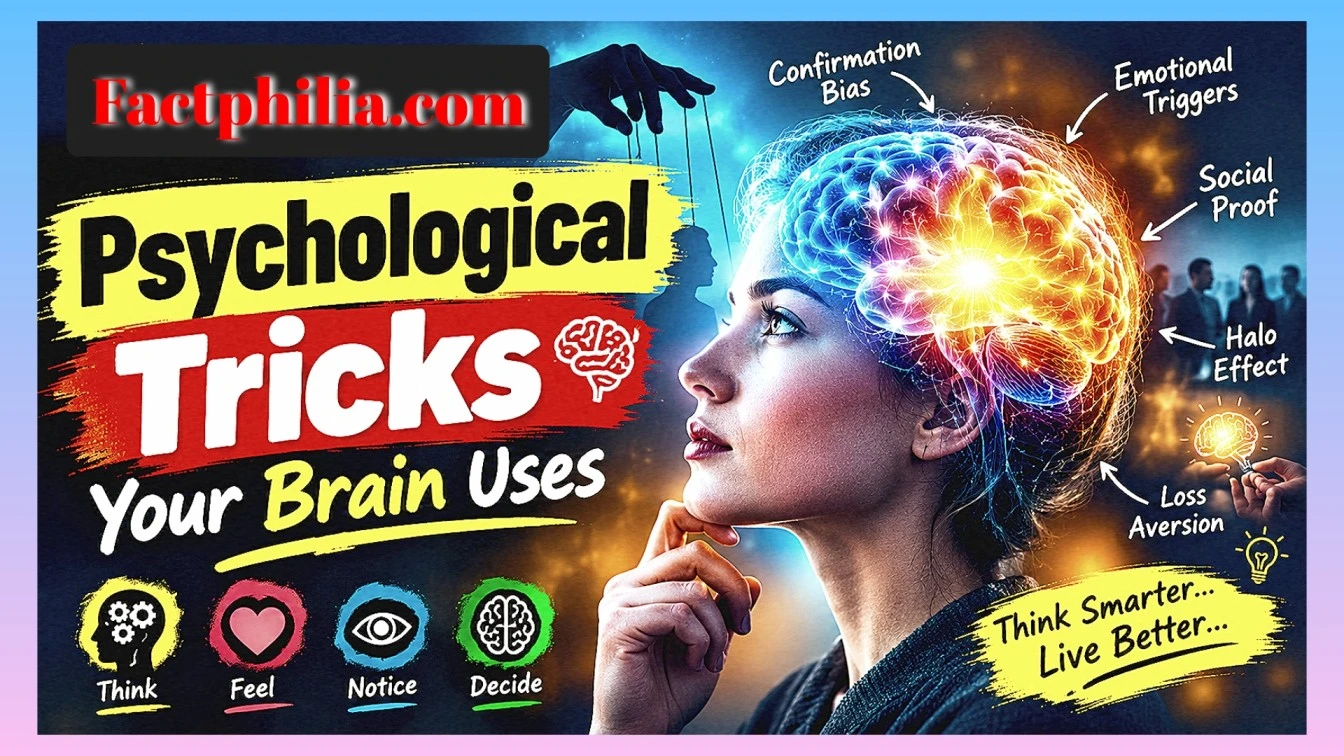
7 Dark Psychological Tricks Your Brain Uses Without You Even Realizing
7 Psychological tricks your brain uses without you even realizing Have you ever wondered how often y…
7 Dark Psychology Facts About Yourself That You’re Ignoring Right Now
7 Dark Psychology Facts About Yourself That You’re Ignoring Right Now Have you over wondered how you…


Leave a Reply