7 Dark Psychology Facts About Yourself That You’re Ignoring Right Now
Have you over wondered how your brain influences the way you think about yourself ? We often believe that we make decisions with full deliberation, recall our memories accurately, and see the world exactly as it is. However, psychology reveals that the human brain is for more complex than that.
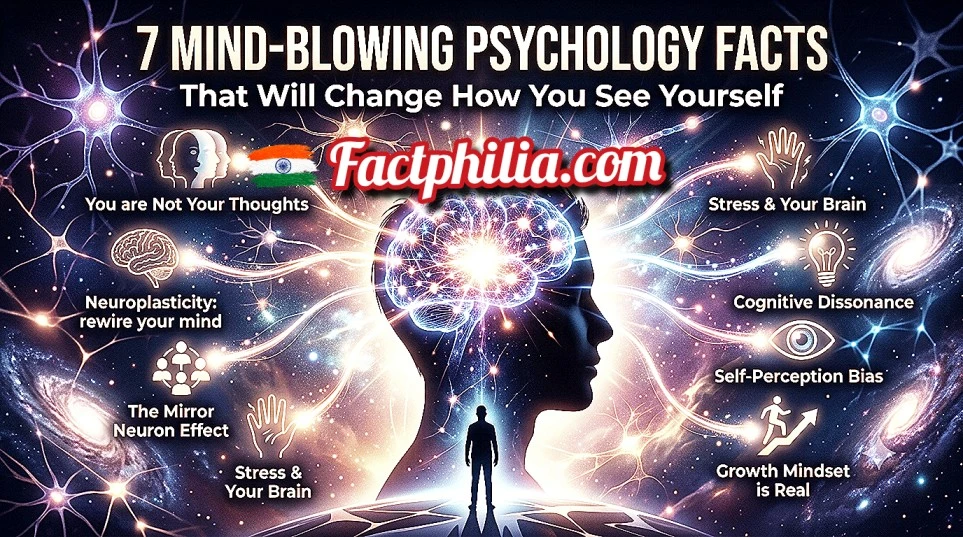
Our thoughts, memories, emotions, the way we interpret others’ behavior, and even our self-perception are influenced by various psychological processes. Social psychology helps us understand how we view ourselves and others, and how these perceptions shape our behavior and beliefs.
Today we will explore 7 psychological facts that might compel you to view your mind and behavior from a fresh perspective. These mind-blowing facts are not merely interesting; they are also evident in our everyday lives.
1. Your Brain does not record Memories exactly like a Camera
We often think our memory works like a camera recording events exactly as they happened and playing them back precisely when needed. But that is not the case.

\Memory is an active process. When we recall an event, our current mindset, post experiences, expectation and information acquired later can all influence that memory. This is why two people might describe the same event in different ways.
For instance, if your feelings about a post relationship have changed or if you rarely think about it anymore you might recall past events from that relationship differently due to the influence of your current emotions.
Psychology facts, not every memory is a perfectly accurate record.
2 Why do you place such high importance on information related in yourself ?
Have you ever noticed that when someone talks about you, your attention is immediately drawn to what they are saying ?

Psychology has identified a specific bias regarding self related information. Research reviews indicate that, in terms of perception, attention and memory, people prioritize information connected to themselves over information related to others.
That is why hearing our own name, seeing a comment about ourselves, or hearing something related to our own experiences stands out so sharply in a conversation, instantly capturing our full focus.
Psychology facts, Our brain does not merely process the World: It also filters information through the lens of our own perspective.
3. Sometimes, your brain focuses more on things that align with your existing beliefs; why does this happen ?
Suppose you already believe that a girl named Priya doesn’t like you. If you message her and she replies late, you might feel she is deliberately ignoring you.

However, if she replies quickly, you might simply view it as a normal occurrence and move on.
This is an example of “confirmation bias,” where a person tends to place greater importance on information that supports their existing beliefs or expectations while downplaying contradictory information.
This is why, at times, our brains seek out things that reinforce our preconceived notions rather than searching for the actual truth.
Understanding this psychology facts can teach you to question you own way of thinking.
4. Repeatedly heard information can seem true
If you hear something repeatedly or meet a particular person often, they begin to feel more familiar to you over time. Familiarity can sometimes influence how believable we find certain statement or that specific person to be.
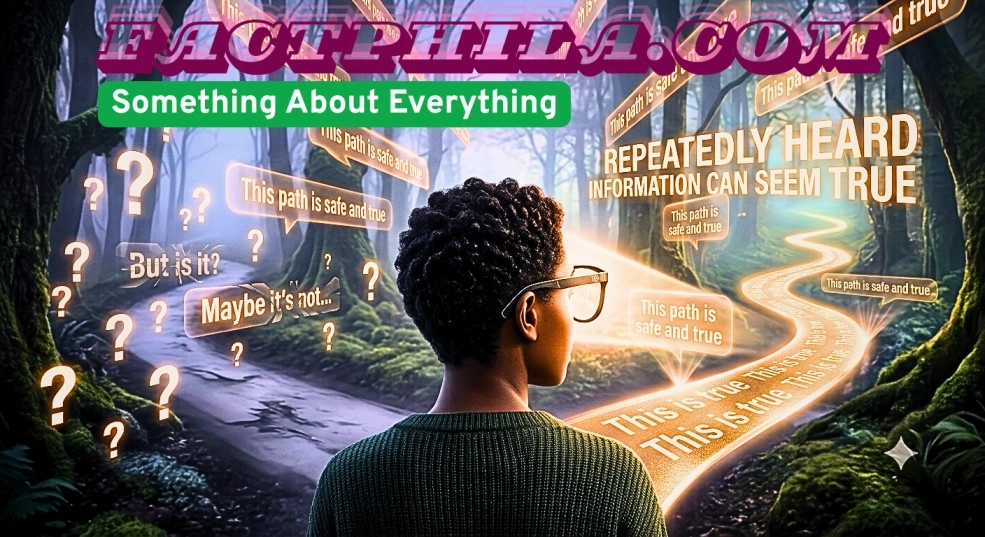
In psychology, this is known as the “illusory truth effect.” A recent, large – scale systematic review and meta – analysis which examined data from 182 studies and 31184 participants found evidence of a tendency to perceive statements as more truthful following repeated exposure.
This does not mean that something becomes true simply because it has heard repeatedly. Rather, the issue is that familiarity and truth are not always the some thing.
Therefore, you should not accept a claim on social media as true simply because you have seen it multiple times.
5. Why Your Confidence isn’t always an accurate indicator of your accuracy
Often, we feel so confident about something that we believe we simply cannot be wrong. However, psychological research shows that confidence and actual accuracy do not always align.

In the case of “overconfidence bias,” a person overestimates their ability, performance or the accuracy of their beliefs compared to reality.
For instance, a student might assume they will perform exceptionally well on an exam- even without adequate preparation – simply because they have great confidence in their abilities.
Confidence is a good thing, but high confidence does not always equate to high accuracy.
Understanding this psychology facts can help you be more open to feedback and willing to acknowledge you mistakes.
6. It is true that we attribute our success to ourselves while blaming external circumstances for our failures.
Suppose you have executed an important task exceptionally well and succeeded; you tend to believe this happened because of your hard work and talent.

However, if that same task goes wrong, you might claim that the timing was bad, the circumstances were unfavorable, or that you didn’t receive adequate support from others.
In psychology, this is to the “self-serving bias.” According to APA educational psychology materials, this involves a tendency to take credit for success while attributing responsibility for failure to external factors.
While this tendency varies across individuals and situations, understanding it can help enhance self-awareness.
If this same situation had happened to someone else, would i offer them the same explanation?
7. How you view yourself influences your behavior.
The way you perceive yourself impacts your behavior and the choices you make.

If a person defines themselves by constantly saying. “This is just how I am,” they often underestimate the possibility of changing their behavior. On the other hand, if they view themselves as someone capable of learning and changing, they adopt a different approach in new situations.
Social psychology studies how our self-perception, beliefs, and social environment influence our behavior and decisions.
This does not mean that positive thinking alone will change everything. Rather, the point is that the beliefs we hold about ourselves can become an integral part of our choices and behavior.
Why are these psychological facts important for your life?
The most interesting aspect of these mind-blowing psychological facts is that many of them operate quietly in our daily lives.
You might from quick opinions about people.
You might assume your past memories are entirely accurate.
You might pay more attention to information that supports your existing beliefs.
You might explain your successes and failures in different ways.
The benefit of understanding these processes is that, instead of immediately accepting your thoughts as absolute truth, you can begin to observe them.
The aim of psychology is not to label humans as irrational; rather, it is to understand how our minds employ various shortcuts and psychological mechanisms to process information. Cognitive psychology studies perception, memory, learning, decision-making and other mental processes in this very context.
Conclusion
Your mind is for more complex than you think.
These 7 psychological facts teach us something important; we likely know for less about our minds then we realize.
Our memories can change, our perceptions can be flawed, existing beliefs can influence does not always guarantee accuracy.
Yet this is precisely what makes psychology so fascinating.
When you begin to observe your thoughts and behavior with a sense of detachment, you can understand yourself better. And perhaps this is the greatest lesson to be drawn from these mind-blowing psychological facts.
Understanding you mind is not merely about learning psychology – it is the beginning of understanding yourself.
Explore More Intresting Facts
Stay Connect With Us On Social Media
Frequently Asked Questions (FAQs)
1. What are psychology facts ?
Psychology facts are research – based findings and concepts that help us understand human thoughts, emotions, memory, perception and behavior.
2. What are the most interesting psychology fact ?
A fascinating fact is that human memory is not perfect like a video recorder; our memories can be influenced by subsequent information, expectations and current beliefs.
3. What is confirmation bias in psychology ?
Confirmation bias is the tendency for individuals to place greater importance on information that supports their existing beliefs while downplaying contradictory information.
4. Can psychology change the way we see ourselves ?
Yes. Psychology can help us understand how our perceptions, beliefs, memories and social experiences influence our behavior and self-view.
5. Are all popular psychology facts scientifically proven ?
No. Many myths and oversimplified claims circulate on the internet under the guise of psychology. ? Therefore, it is best to consult reliable research and credible psychological sources before sharing any psychological fact. The APA also emphasizes debunking many popular misconceptions about psychology.