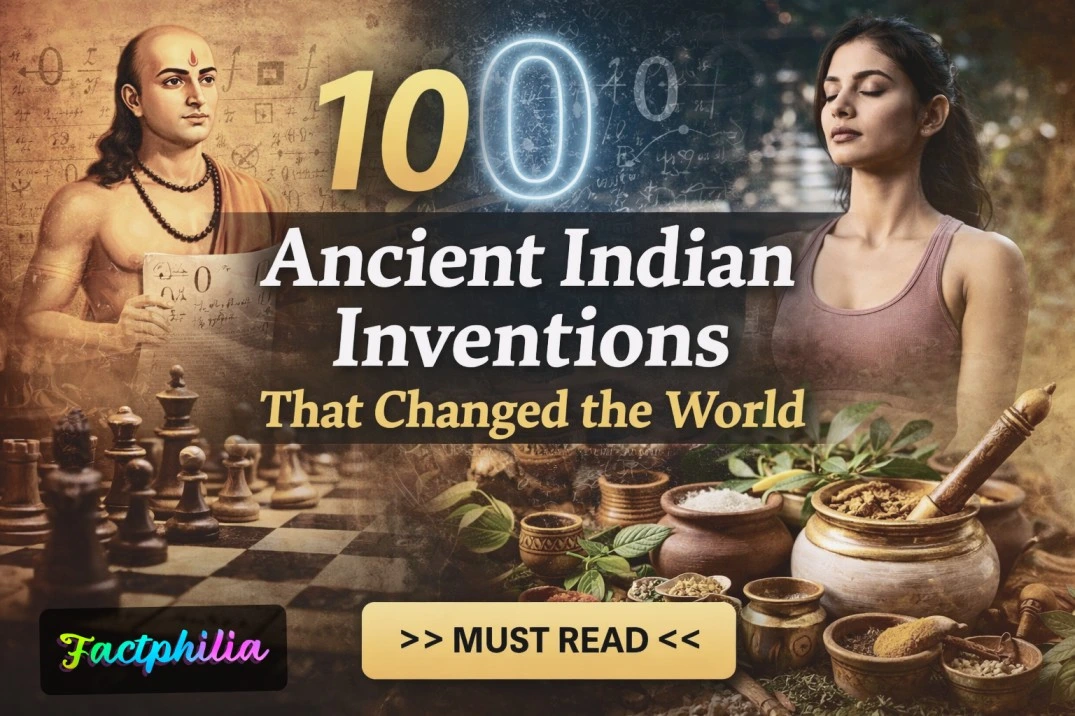
Surprising 10 Ancient Indian Inventions That Changed the World
India is renowned not only for its culture, yoga, and spirituality, but also for many great inventions in science, mathematics, medicine, and technology. Thousands of years ago, Indian scholars and scientists created inventions whose impact is still visible throughout the world.
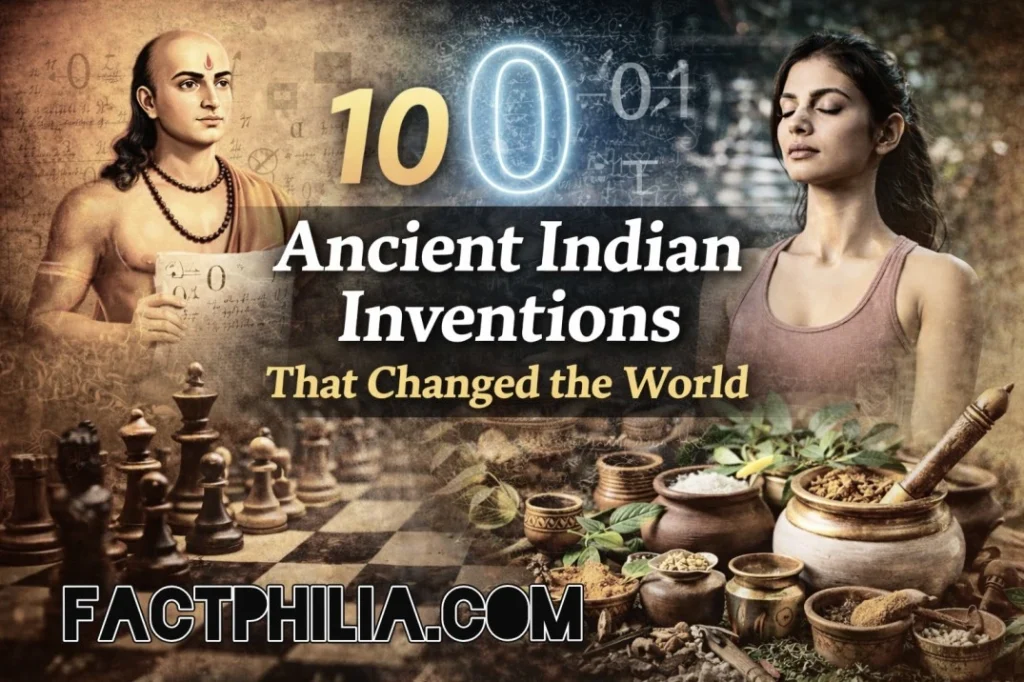
Let’s explore 10 ancient Indian inventions that have played a major role in advancing human civilization.
Table of Contents
1. Zero
The invention of zero is considered one of the most important discoveries in the history of mathematics.
Ancient Indian mathematician Brahmagupta clearly explained the mathematical rules of zero in the 7th century.
Today, computers, mathematics, science, and engineering—everything begins and ends with zero; nothing is possible without zero.
The History and Significance of Zero
Zero is one of the most revolutionary mathematical discoveries in human civilization. Its systematic usage emerged in ancient India between the 5th and 7th centuries. In 628 CE, the Indian mathematician Brahmagupta explicitly articulated the mathematical rules governing zero in his treatise, Brahmasphutasiddhanta. He explained that adding zero to, or subtracting zero from, any number leaves the number unchanged. Zero enabled the development of the decimal system, thereby simplifying calculations. Today, zero plays a pivotal role in every field—from computers and digital technology to science, banking, and space research—and is, therefore, regarded as the foundation of modern mathematics and technology.
2. Decimal System
The decimal number system used worldwide originated in India.
Indian mathematicians developed a system of numbers from 0 to 9, which was later adopted by Arab countries and then Europe.
Today, mathematical calculations throughout the world are based on this system.
3. Ayurveda
Ayurveda is one of the oldest and most trusted medical systems in the entire world.
The ancient texts Charaka Samhita and Sushruta Samhita provide detailed information on the treatment, medicines, and lifestyle of many diseases.
Even today, people around the world use Ayurveda and herbal medicine.
4. Surgery
The ancient Indian physician Sushruta is called the Father of Surgery.
He described over 300 surgical procedures and over 120 surgical instruments.
He also described techniques such as plastic surgery and cataract surgery.
5. Yoga
Today, people all over the world practice yoga for health and mental peace.
Yoga originated in ancient India and was systematically explained by Patanjali in his treatise, Yoga Sutras of Patanjali.
Today, yoga has gained so much global importance that the United Nations declared June 21st as International Day of Yoga.
6. Chess
The world-famous game of chess originated in India.
In ancient India, it was called Chaturanga. The game later spread to Persia and Europe, and today it has become the world’s most popular strategy game.
7. Wootz Steel
Wootz steel produced in ancient India was considered the highest quality steel in the world.
This steel was so strong and sharp that weapons made from it were renowned worldwide.
It is said that the famous Damascus steel was also inspired by this Indian technology.
8. Shampoo
The shampoo used in every household today also originated in India.
The word “shampoo” is derived from the Sanskrit word “champu,” which means massage.
In ancient India, people cleaned their hair with herbs and natural substances.
9. Buttons
Archaeologists have found decorative buttons in the Indus Valley Civilization.
These buttons are believed to be approximately 5,000 years old and indicate that textile design and fashion were quite advanced in ancient India.
10. Ruler
Measuring scales were also used in the Indus Valley Civilization.
Archaeological discoveries have uncovered scales made of stone and ivory, demonstrating the existence of precise measurement and engineering skills at that time.
Conclusion
Ancient India was not only a center of spirituality, but also a leading center of science, mathematics, medicine, and technology.
From zero to yoga, surgery, and chess—these inventions shaped human civilization, and the entire world continues to benefit from them today.
This clearly demonstrates the profound significance of ancient Indian knowledge and science in human history.
More Interesting Fact Visit My Blog Page
People Like Also
Unbelievable: Top 10 Space Exploration Facts in 2026 That Will Shock You
7 Amazing Psychology Secrets Behind Human Behavior: Proven to Change the Way You Think
Contact Us on Social Media
FAQ Frequency Ask Questions
What are the most important ancient Indian inventions?
Some of the most important ancient Indian inventions include Zero, the Decimal System, Ayurveda, Yoga, Chess, Surgery, Shampoo, and Wootz Steel, which had a major impact on science, medicine, and daily life around the world.
Who invented zero in ancient India?
The mathematical concept of zero was formally described by the Indian mathematician Brahmagupta in the 7th century, making it one of the most important contributions to modern mathematics.
What are some medical inventions from ancient India?
Ancient India contributed greatly to medicine through Ayurveda and early surgical techniques. The physician Sushruta is known as the Father of Surgery for describing many surgical procedures in the text Sushruta Samhita.
Did chess originate in India?
Yes, the modern game of chess originated in ancient India as a strategy game called Chaturanga, which later spread to Persia and Europe and evolved into modern chess.
How did ancient Indian mathematics influence the world?
Ancient Indian mathematicians developed the decimal number system and the concept of zero, which became the foundation of modern mathematics and computing.
What ancient Indian inventions are still used today?
Many ancient Indian inventions are still widely used today, including zero, the decimal system, yoga, herbal medicine, chess, and shampoo.
Why are ancient Indian inventions important in world history?
Ancient Indian inventions helped shape modern science, mathematics, medicine, and culture, influencing civilizations across Asia, the Middle East, and Europe.
Related Stories
10 Ancient Indian Inventions That Changed the World
Surprising 10 Ancient Indian Inventions That Changed the World India is renowned not only for…

10 Psychological Facts About Human Behavior and Attraction
10 Psychological Facts About Human Behavior and Attraction Human behavior and attraction have always been…

Unbelievable: Top 10 Space Exploration Facts in 2026 That Will Shock You
Top 10 Space Exploration Facts in 2026 That Will Shock You Did you know that…

7 Amazing Psychology Secrets Behind Human Behavior: Proven to Change the Way You Think
🧠 Psychology Secrets Behind Human Behavior: That Will Change the Way You Think Have you…

How does the human brain work? 5 Psychology facts that will change your thinking
Have you ever wondered what’s happening inside the brain when we think? How does the…

Why Do Humans Think This Way? Science Reveals the Hidden Truth
Why Do Humans Think This Way? Science Reveals the Hidden Truth Have you ever wondered…